The year the tree remembers a famine.
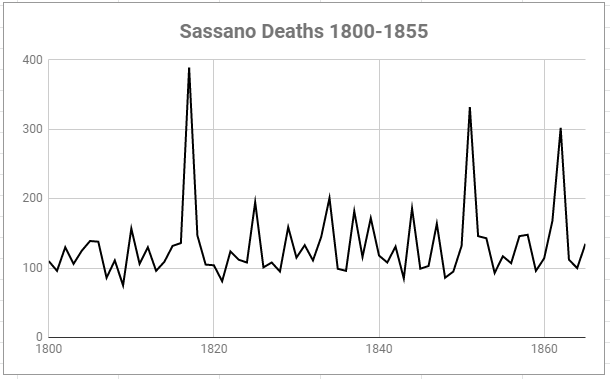
Between 1815 and 1819, a volcanic eruption at Mount Tambora in Indonesia — the largest in recorded history — cooled the global climate enough to trigger widespread crop failure across Europe. 1816 became known as "The Year Without a Summer." Famine followed, and where famine goes, typhus and other disease follow close behind. Southern Italy was hit hard. In August 2021, Giuseppina Dede of the Museo del Cognome in Padula, Italy — a town just down the road from Sassano — independently confirmed this from her own records: a typhus fever epidemic, tifo petecchiale, struck the area in 1817. That's a genuine, unprompted match to what the tree already showed.
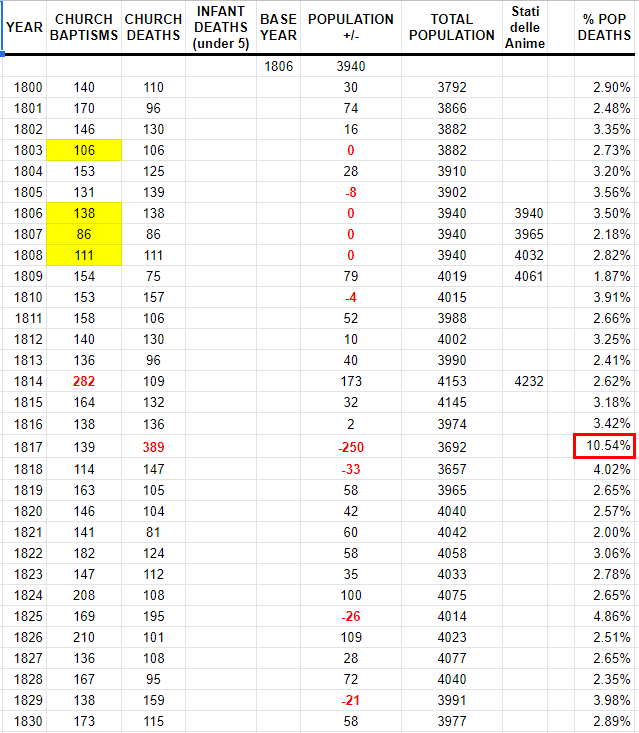
A closer look at the year-by-year numbers shows the spike is narrower than it first appears. Against a baseline of about 113 deaths a year across 1795–1815, 1816 (134 deaths, 1.19×) and 1818 (146 deaths, 1.30×) both sit inside the ordinary range of year-to-year variation — no different, really, from other unremarkable years nearby like 1812 (1.15×) or 1815 (1.28×). 1817 alone is the true outlier: 390 deaths, 3.46× the baseline, and by a wide margin the worst single year among the four headline crises on this page. What briefly looked like a three-year crisis turns out, on closer inspection, to be one catastrophic year bracketed by two ordinary ones — so this page treats 1817 on its own, not as part of a wider 1816–1818 window. 1817's count held at 390 this update, and with the surrounding 1795–1815 baseline barely moving (about 112.7 a year), its multiple stays at 3.46×. The town's own parish population records tell the same concentrated story at an even sharper edge: against a population of roughly 3,700, 1817 saw 389 church deaths — a 10.5% death rate in a single year, more than triple the surrounding decades' norm. The tree's own 1817 count now sits one above that parish register figure and just two short of the 392 deaths recorded in the civil register.
Breaking 1817's 390 deaths down by age at death: 202 (52%) were adults (15 and older), 143 (37%) were children between 1 and 14, and 45 (12%) were infants under a year old. This was a crisis that reached every generation of a household at once — it didn't spare working-age adults to take only the very young, the way some epidemics do. Against the 1795–1815 baseline (47% adult, 33% child, 20% infant), the shift is real but modest: 1817 skewed a little further toward adults and children and noticeably away from infants — not a dramatically different mortality profile, just a much bigger version of the ordinary one.
The hardest-hit surname is Calandriello (19 deaths in 1817 alone), followed by d'Amato and d'Alessio, tied at 16 each. Forty-one individual families lost two or more children within that single year.
No single family shows the full weight of that famine better than Isidoro d'Amato's. Between April and December 1817 alone, the crisis took nine members of his extended family across three generations: two of his siblings (Rosaria Giovanna in April, Donato Antonio in May), his wife Albabella Cusati (August), two of his adult children (Vincenzo Ferdinando in November, Rosa Maria in December), three of his grandchildren (a one-year-old and an eight-year-old among them) — and finally Isidoro himself, on 30 November, at 66. All nine deaths fall within calendar-year 1817 — nothing here bleeds into the neighboring, unremarkable years either side of it. Nine deaths in one household in a single year is about as complete a picture of what this crisis actually did to a family as the records offer anywhere in the tree.
Two other households show the same single, brutal year from different angles. Rocco Pellegrino & Gaetana Vasquez lost five members of their household — both parents and three of their children — entirely within 1817: Rocco himself on 9 February, their son Giuseppe (6) on 3 September, daughter Erminia (2) on 11 September, Gaetana on 10 October, and daughter Giacomina (10) a week later on 17 October. Of their six recorded children, only one, Maria, survived the year — she lived on to 1871. And Cono Caiafa & Giacomina d'Onza lost three of their children within an 11-week span in mid-to-late 1817, with Giacomina herself dying in the middle of it, on 27 Aug, not yet 40 — a household that lost its mother alongside its children, not just its children, all inside that same single year.
Not every family's hardest stretch lines up quite so neatly with the town-wide numbers, and one household is worth including precisely because it doesn't. Giuseppe Gennaro Russo & Angelica Burzo lost five of their adult children — Gioacchino Michele (63), Vincenzo (55), Francesca Catarina (42), Salvatore Gesualdo (67), and Santoro (61) — across barely more than two years, but only two of those five deaths, Francesca Catarina's in February and Salvatore Gesualdo's in August, actually fall in 1817 itself; the other three fall in 1816 and 1818, the two years the town-wide data now shows as ordinary. Five siblings, all already well into middle age or older, dying in close succession across three consecutive years reads less like a town-wide catastrophe reaching this one family and more like a family with some shared vulnerability of its own — age, a shared household, fragile health passed among them — that happened to unfold alongside the wider crisis rather than because of it. It's a useful reminder that the aggregate data drawing a clean line around 1817 doesn't mean every family's own worst years lined up inside it.
"Between April and December 1817, Isidoro d'Amato's family lost nine members across three generations — his wife, two siblings, two children, three grandchildren, and Isidoro himself."